Posts

Posts mit dem Label "Ethics" werden angezeigt.

God Is Everywhere: Spinoza, Nietzsche, and the Immanent Affirmation of Life

Bild
Raphael ’s Nietzsche & Spinoza, Fresco. AI art “I am utterly amazed, utterly enchanted! I have a precursor, and what a precursor! I hardly knew Spinoza: that I should have turned to him just now, was inspired by ‘instinct.’ Not only is his overall tendency like mine—to make knowledge the most powerful affect—but in five main points of doctrine I recognize myself; this most unusual and loneliest thinker is closest to me precisely in these matters: he denies the freedom of the will, teleology, the moral world order, the unegoistic, and evil. Even though the divergences are admittedly tremendous, they are due more to the difference in time, culture, and science. In summa: my lonesomeness, which, as on very high mountains, often made it hard for me to breathe and made my blood rush out, is now at least a twosomeness.” ¹ Introduction When Nietzsche discovered his kinship with Spinoza, it was not merely a passing remark or a casual nod to influence. His exclamation signals the reco...
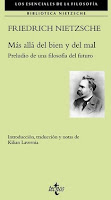
Beyond Good and Evil: Nietzsche and the Deconstruction of Moral Values

Bild
  Introduction In the late 19th century, Friedrich Nietzsche experienced a period of personal isolation and commercial failures that profoundly influenced his intellectual production. Amid this adversity emerged one of his most emblematic works, Beyond Good and Evil , a book that challenges the foundations of Western philosophy and questions traditional ethical values. In this work, Nietzsche argues that the moral dichotomies and value antitheses that have dominated philosophical thought are not absolute but conventional constructions that must be overcome. This argument paved the way for new ways of thinking, later influencing philosophical movements like  existentialism , poststructuralism and Jacques Derrida's deconstruction, among others. The radical and provocative nature of Beyond Good and Evil led to its being perceived as a “dangerous” work—a label that does not censor the philosopher but underscores his capacity to revolutionize traditional ideas. The depth and b...